The Statement â€å“if You Come With Me, Then We Can Go Shoppingã¢â‚¬â Is a __________.
There are many occasions in which we need to describe an effect or action that happened, and very often that includes repeating what someone said. Such occasions can include a social situation as well every bit in a piece of work email or presentation. In society to describe what people said at that place are two different types of speech – direct speech and indirect spoken communication (or reported speech).
Read on to find out more well-nigh these forms and improve your English storytelling skills.
Direct Oral communication
When we want to describe what someone said, i option is to use directly speech. We use directly oral communication when we just echo what someone says, putting the phrase betwixt spoken language marks:
- Paul came in and said, "I'one thousand really hungry."
It is very common to see straight speech used in books or in a newspaper article. For example:
- The local MP said, "We plan to make this urban center a safer place for anybody."
Equally yous can run into, with directly speech it is common to use the verb 'to say' ('said' in the past). Simply you can also notice other verbs used to bespeak directly speech such as 'ask', 'reply', and 'shout'. For case:
- When Mrs Diaz opened the door, I asked, "Have you seen Lee?"
- She replied, "No, I haven't seen him since lunchtime."
- The dominate was angry and shouted, "Why isn't he here? He hasn't finished that report yet!"
Indirect Speech
When we want to report what someone said without speech marks and without necessarily using exactly the same words, we can apply indirect speech (also called reported speech). For example:
- Straight speech: "We're quite cold in here."
- Indirect spoken language: They say (that) they're common cold.
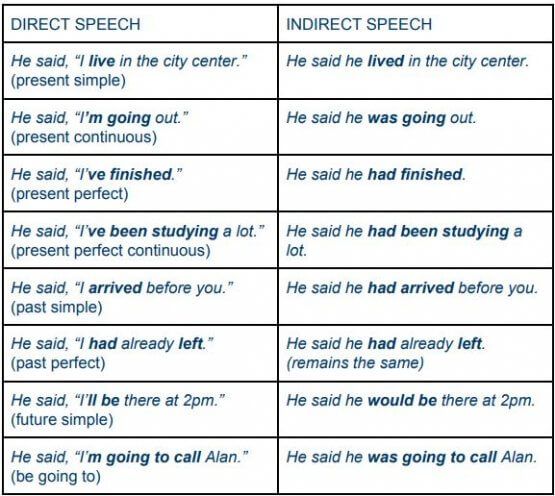
When we report what someone says in the present simple, as in the above judgement, we unremarkably don't change the tense, we simply change the subject. However, when we written report things in the by, we usually alter the tense past moving it one step dorsum. For example, in the following sentence the nowadays simple becomes the past simple in indirect speech:
- Direct speech: "I have a new car."
- Indirect spoken language: He said he had a new car.
All the other tenses follow a like modify in indirect speech. Here is an example for all the main tenses:
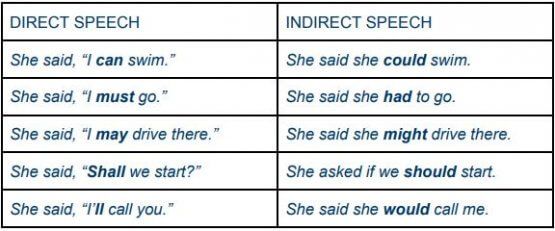
The aforementioned dominion of moving the tenses one pace back also applies to modal verbs. For case:
Using 'say' or 'tell'
As an alternative to using 'say' we tin can also use 'tell' ('told' in the past) in reported spoken communication, only in this case you need to add together the object pronoun. For example:
- He told me he was going to call Alan.
- They told her they would arrive a little late.
- Y'all told us yous'd already finished the order.
Changing Time Expressions
Sometimes it'south necessary to alter the time expressions when you report speech, particularly when yous are speaking about the past and the time reference no longer applies. For example:
- Direct speech: "I'm seeing my blood brother tomorrow ."
- Indirect speech communication: She said she was seeing her brother the following day .
Here are some other examples:
- Straight speech: "I had a headache yesterday ."
- Indirect speech communication: You said you'd had a headache the mean solar day before yesterday .
- Direct speech communication: "It's been raining since this afternoon ."
- Indirect speech: He said it'd been raining since that afternoon .
- Direct spoken communication: "I haven't seen them since last calendar week ."
- Indirect speech: She said she hadn't seen them since the previous calendar week .
Reporting Questions
When you report a question you need to modify the interrogative grade into an affirmative sentence, putting the verb tense 1 step dorsum, every bit with normal reported speech.
There are two types of questions that we can written report – questions that have a yes/no response, and questions that brainstorm with a question word similar 'what', 'where', 'who' etc. When we study a yes/no question, nosotros use 'if'. For example:
- Direct oral communication: "Practise they live here?"
- Indirect speech communication: You asked me if they lived here.
As you can see, in the reported version of the question, 'practise' is eliminated because it is no longer a question, and the verb 'live' becomes 'lived'.
For questions starting with question words similar 'what', 'where', 'when', 'who', etc., we report the question using the question word but change the interrogative class to the affirmative form. For example:
- Direct speech: "Where do they live?"
- Indirect speech: You asked me where they lived.
- Direct speech: "When are you leaving?"
- Indirect spoken communication: He asked the states when we were leaving.
- Direct speech: "How volition they go here?"
- Indirect speech: She asked me how they would get here.
When we report a question nosotros normally use the verb 'ask'. As with the verb 'to tell', the verb 'to enquire' is normally followed past an object pronoun, though it is possible to omit information technology.
Reporting Orders and Requests
When you lot give someone an order, y'all use the imperative class, which ways using just the verb without a field of study. For instance:
- " Call me dorsum subsequently."
- " Take a seat."
- " Don't do that!"
To report an order we use 'tell' and the infinitive of the verb. For example:
- You lot told me to call yous back after.
- He told me to take a seat.
- She told u.s.a. not to do that.
When yous make a asking, you normally apply words like 'can', 'could', or 'will'. For example:
- "Could yous call me dorsum later?"
- "Volition you lot accept a seat?"
- "Can y'all not do that please?"
To report a asking, we use the verb 'to ask' and the infinitive form of the verb. For example:
- Yous asked me to call you back later.
- He asked me to have a seat.
- She asked us not to practice that.
At present you lot've seen how nosotros use direct and indirect oral communication, practice using them yourself. An splendid and like shooting fish in a barrel fashion to see how they are used is past reading a short story in English or a news article online, because stories and articles contain many examples of reported speech.
Source: https://www.wallstreetenglish.com/exercises/direct-and-indirect-speech-exercises
0 Response to "The Statement â€å“if You Come With Me, Then We Can Go Shoppingã¢â‚¬â Is a __________."
Enregistrer un commentaire